Summer in Italy for US Travelers: Itinerary, Packing & Travel Tips
Italy in the summer runs hot, moves fast, and rewards travelers who arrive prepared. It covers what the season actually looks like across north and south, a 10-day itinerary, three alternative routes, a complete packing list, and practical tips for US travelers.
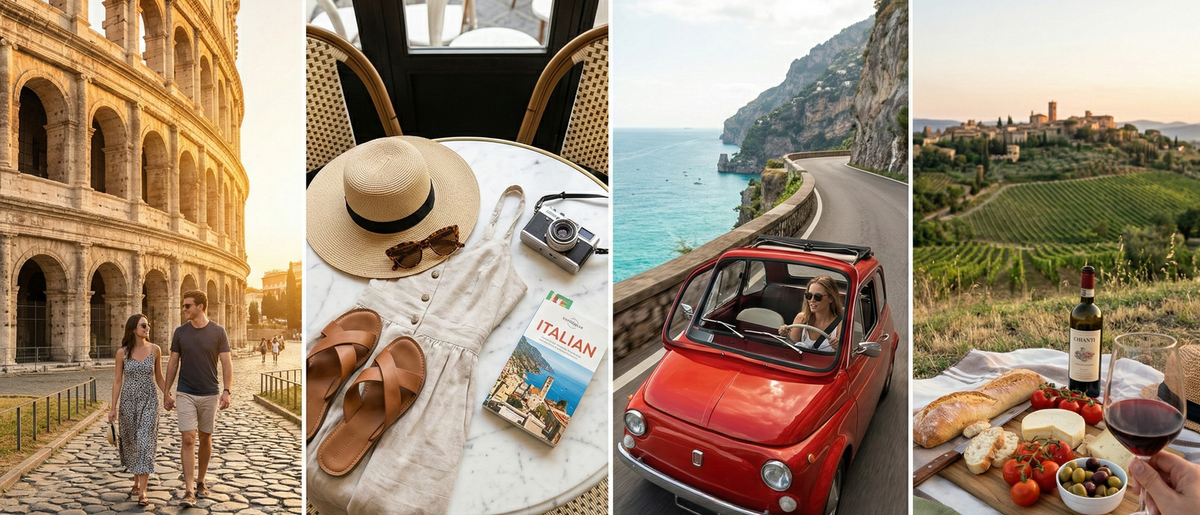
Italy is the most visited country in Europe for a reason. It operates at full intensity in the warmer months: blazing heat, packed piazzas, long restaurant queues, and sunsets over ancient ruins that justify every inconvenience. For US travelers, summer in Italy tends to land somewhere between overwhelming and transcendent, often within the same afternoon.
This covers everything you need to arrive prepared: what the season actually looks like on the ground, a 10-day itinerary built for first-timers, alternative routes for repeat visitors, a practical packing list, and the tips that separate smooth Italy trips from stressful ones.
Before departure, a Jetpac Italy eSIM means you step off the plane connected, with maps, translation apps, and booking platforms ready to go without hunting for a local SIM at the airport.

What is summer in Italy really like?
Italy in the summer is not one experience. It is three, depending on where you go.
Weather
Northern Italy, including Milan, the Lakes, and the Dolomites, is warm rather than scorching in June and early July, with temperatures typically between 75°F and 88°F. Afternoon thunderstorms are common in the mountains.
Central Italy, Rome and Tuscany, runs hotter, regularly reaching 95°F to 100°F in July and August. Southern Italy and Sicily are the most extreme, with temperatures that can push past 104°F in August and humidity that makes shade a necessity rather than a preference.
July and August are the hottest and most crowded months. June and September offer a meaningful step down in both temperature and tourist numbers without sacrificing good weather.
Crowds
The honest reality of Italy in the summer is that the most famous sites are genuinely crowded. The Colosseum, the Vatican Museums, the Uffizi, and the Amalfi Coast road all operate at or beyond comfortable capacity in July and August. Queues of two to three hours without pre-booked tickets are common at major sites.
Ferragosto, the national holiday on August 15, triggers a mass domestic migration. Many small restaurants, family-run shops, and local services close for one to two weeks around this date, particularly in cities.
Coastal and rural areas are filled with Italian vacationers. If you are traveling around August 15, book everything well in advance.
Pros and Cons
Pros: Long daylight hours, warm evenings perfect for outdoor dining, all attractions fully operational, festivals and outdoor cinema in most cities, best swimming conditions on the coasts and lakes.
Cons: Extreme heat in the south and center, peak pricing on flights and accommodation, crowds at major tourist sites, Ferragosto closures in August, and the need to pre-book almost everything. Despite the trade-offs, summer in Italy remains the most requested time of year for US travelers visiting Europe
The verdict: summer in Italy is worth it for travelers who plan. It rewards early risers, advance bookers, and those willing to explore beyond the top three cities.
Here’s a perfect 10-day Italy Summer itinerary
This route moves from Rome north through Pompeii and Cinque Terre to Milan, covering ancient history, coastal scenery, and city culture across ten days.
Days 1 to 3 - Rome
Arrive in Rome and spend three days exploring the ancient city and the Vatican.
Day one: Cover the Colosseum, Roman Forum, and Palatine Hill, all bookable together with a single combined ticket bought in advance. Arrive at opening time, 9 am, before the heat builds.
Day two: Vatican Museums and Sistine Chapel in the morning, booked for an 8 am entry slot, then St. Peter's Basilica and the climb to the dome in the afternoon.
Day three: Trastevere neighborhood in the morning, the Pantheon at opening time before the crowds, and Campo de' Fiori market if visiting on a weekday morning.
Eat: Supplì (fried rice balls) for street food, carbonara for dinner.
Drink: Espresso standing at a bar.
Avoid: tourist menus near the major sites.
Days 4 to 5 - Naples and Pompeii
Naples is chaotic, loud, and genuinely wonderful. Pizza here is a completely different product from what most US travelers know: softer, wetter, cooked in wood-fired ovens at 900°F. Pizzeria Starita, Da Michele, and Sorbillo are the names worth queuing for.
Day four: Take the high-speed Frecciarossa train from Rome to Naples, roughly 70 minutes.
Day five: Take the Circumvesuviana train from Naples Centrale to Pompeii Scavi station, a 40-minute ride. Arrive at opening time.
The site takes three to four hours to cover properly, and the heat by midday is severe in summer. Bring water, a hat, and sunscreen.
Return to Naples for a final evening before continuing north.
Days 6 to 7 - Cinque Terre
Day six: Board a train from Naples to La Spezia via Rome or directly on Frecciabianca services, then connect to the Cinque Terre villages by regional train.
The five villages, Monterosso, Vernazza, Corniglia, Manarola, and Riomaggiore, are connected by a coastal railway that runs every 15 to 30 minutes.
Vernazza and Manarola are the most photogenic.
Day seven: Monterosso has the only proper beach.
The coastal hiking trail between villages is partially open in summer; check current conditions before visiting.
Swimming from the rocks at Vernazza or Riomaggiore is one of the best experiences the Italian coast has to offer in peak season.
Days 8 to 9 - Milan
Day eight: Board a train from La Spezia to Milan, roughly two hours on Frecciarossa services. Milan operates at a different pace from the rest of Italy: faster, more international, less obviously tourist-oriented.
The Duomo is free to enter cathedral and is extraordinary to visit. Book the rooftop terraces separately for the best views.
Day nine: The Brera neighborhood for evening aperitivo, Navigli canals for outdoor dining along the water, and a day trip to Bergamo's medieval upper city make Milan genuinely worthwhile for two days.
Shopping along Corso Buenos Aires or the Quadrilatero della Moda for those inclined.
Day 10 - Lake Como
Day ten: A day trip from Milan to Lake Como, roughly 45 minutes by train to Como San Giovanni station or Varenna by direct train. Varenna is quieter and more scenic than the main town of Como.
Ferry services connect the villages across the lake. Bellagio sits at the center of the lake's Y-shape and is worth the ferry crossing from Varenna for lunch and an afternoon walk through its terraced gardens.
Return to Milan for a final night before departure.
Alternative Summer Itineraries
Sicily - 7 Days
It is not necessary for every summer in Italy to follow the same Rome-Florence-Venice circuit. Sicily deserves its own trip rather than a rushed addition to a mainland itinerary.
Palermo, Cefalù, Agrigento's Valley of the Temples, and the Baroque towns of the southeast, Noto, Ragusa, and Modica, form a complete and deeply rewarding circuit. Fly into Palermo, out of Catania. Rent a car outside the cities.
Note: Sicily in July and August is extremely hot. June and September are significantly more comfortable for outdoor sightseeing.
Northern Lakes and Dolomites - 5 Days
Milan as a base, with day trips to Lake Como and Lake Maggiore, followed by two days in the Dolomites around Cortina d'Ampezzo or the Val Gardena.
The Dolomites are cooler than the rest of Italy in summer, genuinely spectacular, and far less crowded than the coastal hotspots.
Puglia and the Heel - 7 Days
Bari, Alberobello's trulli houses, Lecce's baroque architecture, Otranto's castle and crystal-clear Adriatic water, and Polignano a Mare's cliff-diving cove form one of the most underrated summer circuits in Italy.
Fly into Bari, rent a car, and move south. Puglia is less visited than Tuscany and Amalfi and offers exceptional local food, olive oil, burrata, and orecchiette at prices well below the main tourist trail.
What to pack for Italy in summer?
Clothes
Packing right makes a real difference because summer in Italy means moving between intense outdoor heat and aggressively air-conditioned interiors multiple times a day.
Lightweight and breathable is the priority. Linen and cotton in neutral tones are practical and culturally appropriate.
Pack two to three short-sleeved tops per person, one pair of lightweight trousers, one pair of shorts, and one smarter outfit for evening dining. Italian evening dress codes are not strict, but a step above beach casual is the norm at decent restaurants.
One essential note before packing for any Italian summer itinerary: bring a lightweight layer for air-conditioned museums, churches, and trains, all of which can be aggressively cold relative to the outdoor heat.
Shoes
Comfortable walking shoes that have been broken in before the trip are non-negotiable. Rome and most Italian cities are paved in cobblestones and uneven stone; new shoes will cause blisters within hours. Bring one pair of sandals for evenings. Flip-flops for beach or pool only.
Heat Essentials
High-SPF sunscreen (50+ recommended, especially in the south). A compact folding fan. A refillable water bottle: Rome's public drinking fountains, called nasoni, provide free, cold, drinkable water throughout the city.
Electrolyte tablets for heavy heat days. A lightweight wide-brim hat.
Travel Adapters
Italy uses Type F and Type L plugs. US devices with two flat prongs need a Type C or Type L adapter. A small universal travel adapter with USB ports is the most practical option and covers Italy's mix of outlet types.
Documents
US passport valid for at least six months beyond travel dates. Italy is part of the Schengen Area; US citizens can visit for up to 90 days in any 180 days without a visa.
From 2025, the ETIAS pre-travel authorization will be required for US passport holders entering the Schengen zone. Check the current ETIAS status before booking.
Print or download: flight confirmations, accommodation addresses, travel insurance documentation, and a copy of your passport's photo page.
eSIM and Connectivity
Italy has strong 4G and 5G coverage across major cities, tourist regions, and most train routes. Rural areas and mountain regions can have patchy service.
A Jetpac eSIM for Italy installed before departure gives you data from the moment you land, covers Italy and 200+ other destinations if your trip extends beyond Italy, and includes unlimited hotspot sharing so travel companions stay connected through one plan.
Tips for Traveling to Italy in the Summer
Before moving into specific tips, one overarching rule applies to Italy in the summer more than almost any other destination: everything that can be pre-booked should be pre-booked. Improvisation is charming in theory and painful in July.
Pre-book everything ticketed: The Colosseum, Vatican Museums, Uffizi, Pompeii, and most major sites sell out days to weeks in advance in summer. Turning up without a ticket in July means a two to three hour queue at minimum, often in direct sunlight.
Visit sites at opening time: Most major Italian attractions open between 8 am and 9 am. Arriving at opening is the single most effective way to see the interiors without crowds and before the worst heat of the day builds.
Dress for churches: Hot weather means light clothing, but Italian churches require covered shoulders and knees for entry. Carry a light scarf or sarong that doubles as a cover-up. Some major churches, including St. Peter's Basilica, will turn visitors away for inappropriate dress.
Know Ferragosto: August 15 is a national holiday and the peak of the Italian summer vacation period. Expect closures, higher prices, and significantly more domestic tourists at coastal and lake destinations. Plan around it or embrace it.
Use trains between cities: Italy's high-speed rail network connects Rome, Florence, Milan, Naples, and Venice quickly and comfortably. Trenitalia and Italo are the two operators. Book early for the best prices on peak summer routes.
Carry cash for small purchases: Italy is increasingly card-friendly, but many bars, small trattorias, and market vendors still prefer or require cash. Keep 50 to 100 euros in cash for daily spending.
Use Rome's nasoni: Rome has over 2,500 public drinking fountains delivering free, cold, drinkable water year-round. Refill your bottle rather than buying plastic.
Stay connected from the moment you land: Navigating Italian cities, finding restaurants not on the tourist trail, reading train boards, and using real-time translation all require reliable data.
A Jetpac eSIM activated before departure removes the airport SIM hunt entirely and keeps your whole group connected on one plan across the whole trip.
Staying connected across Italy without the roaming bill
Traveling through Italy means constant phone use: navigating cobblestone backstreets, translating menus in Sicilian dialect, pulling up timed museum entry tickets, booking last-minute trattorias that only take reservations by phone, and keeping travel companions updated across split itineraries.
US carrier roaming plans charge USD 10-15 per device per day in Italy.
Across a 10-day trip with two active phones, that is USD 200-300 in roaming charges before you have spent a euro on anything else. Airport SIM cards in Italy are sold at inflated prices, require a passport for registration under Italian law, and only cover Italy.
A smarter option for Italy and beyond:
🗺️ One eSIM for Italy, and 200+ destinations
Most Italy trips extend to neighboring countries: France, Croatia, Greece, and Switzerland. A Jetpac eSIM covers 200+ destinations under a single prepaid plan.
No new SIM purchase at each border, no plan switching, no hunting for a carrier shop in a language you do not speak.
You scan a QR code at home, and connectivity follows you across the entire trip.
💶 Know what you are paying before you land in Rome
Italian roaming bills have a way of arriving after a trip and ruining the memory of it. A prepaid Jetpac eSIM sets your data cost before departure. Fast 5G speeds were available. No per-day charges.
No megabyte billing. No explaining a USD 300 phone bill to anyone when you get home.
📡 Hotspot sharing that actually works
Unrestricted hotspot sharing through a single Jetpac eSIM means your travel companion's phone, your tablet for offline maps, and your laptop for work-from-anywhere days at a Milanese café all stay connected through one plan.
No extra cost per device. No daily hotspot caps that run out halfway through a Florence afternoon.
🔄 Italy has multiple carriers. Jetpac picks the best one.
Italy's major carriers, TIM, Vodafone, and WindTre, have different coverage strengths across regions. Jetpac's multi-network switching automatically connects to whichever carrier has the strongest signal in your current location, whether you are in a Rome metro station, a Cinque Terre village, or a Puglia olive grove.
📞 Make calls for restaurant reservations and hotel queries
Italy still runs on phone calls for many reservations, local taxi bookings, and tour confirmations. Voice calls from USD 1.99 for 5 minutes cover what you need without committing to a full international calling plan.
💬 Support available even when it is 2 am in Rome
If connectivity issues arise at any hour, Jetpac support is available around the clock via WhatsApp and email. Useful when you are traveling solo, when you have an early train, or when you simply cannot afford to troubleshoot alone in an unfamiliar city.
FAQs
Is summer a good time to visit Italy?
Yes, with planning. Summer in Italy delivers the best weather, the longest days, and all attractions at full operation. The trade-offs are heat, crowds, and peak pricing. Travelers who pre-book tickets, visit major sites early in the morning, and avoid the worst of August around Ferragosto will find summer an excellent time to visit.
How hot is Italy in the summer?
It depends on the region. Northern Italy and the Lakes typically reach 75°F to 88°F. Rome and central Italy regularly hit 95°F to 100°F in July and August. Southern Italy and Sicily can exceed 104°F in peak summer. Morning and evening temperatures are more manageable; midday in July in Palermo or Naples can be genuinely taxing.
Is Italy too crowded in summer?
The most famous sites are genuinely very crowded in July and August. Pre-booking tickets eliminates most of the queue problem. Visiting at opening time reduces crowds significantly. Less-visited destinations like Puglia, the Dolomites, and smaller Sicilian towns offer a very different experience with far fewer tourists.
Should I visit northern or southern Italy in summer?
Northern Italy is cooler and better suited to summer travel in terms of comfort. The Lakes and Dolomites in particular offer a genuine escape from the heat. Southern Italy and Sicily are more extreme in temperature but more culturally intense and visually dramatic. For a first trip, a north-to-south route that samples both is the most rewarding option.
What should I wear in Italy in summer?
Lightweight, breathable fabrics in linen or cotton. Comfortable, broken-in walking shoes for city days. Covered shoulders and knees for church visits. A light layer for air-conditioned interiors. A wide-brim hat and high-SPF sunscreen are essential, particularly in the south. Avoid heavy denim and synthetic fabrics in the heat.
Is Italy expensive in summer?
Summer is peak season, and prices reflect it. Flights from the US are at their highest between June and August.
Accommodation in Rome, Florence, Venice, and the Amalfi Coast runs significantly higher than in the shoulder season.
Eating at local trattorias away from tourist sites, using the train network over domestic flights, and booking accommodation early can keep costs manageable. Budget for USD 150-250 per person per day at mid-range in major cities, less in the south and rural areas.
Note: Costs in Rome, Venice, and Florence in July and August skew toward the higher end of this range. Budget estimates will vary significantly based on accommodation category and travel style.
Disclaimer
The information in this blog is based on publicly available sources at the time of writing. Temperature ranges, crowd levels, and travel conditions are general estimates based on historical patterns and may vary by year and specific travel dates. Prices, visa requirements, and entry conditions, including ETIAS implementation timelines, are subject to change. We recommend verifying all practical details directly with official sources before your trip. Jetpac is not responsible for any changes after publication.