10 Dream Spots for Summer Vacation in France 2026
From Paris to Chamonix, a summer vacation in France in 2026 covers iconic cities, Mediterranean beaches, Alpine lakes, lavender fields, and world-class food. Budget from USD 1,216 (€1,057) for 3 days. Book flights 6-9 months out and TGV trains as early as possible.
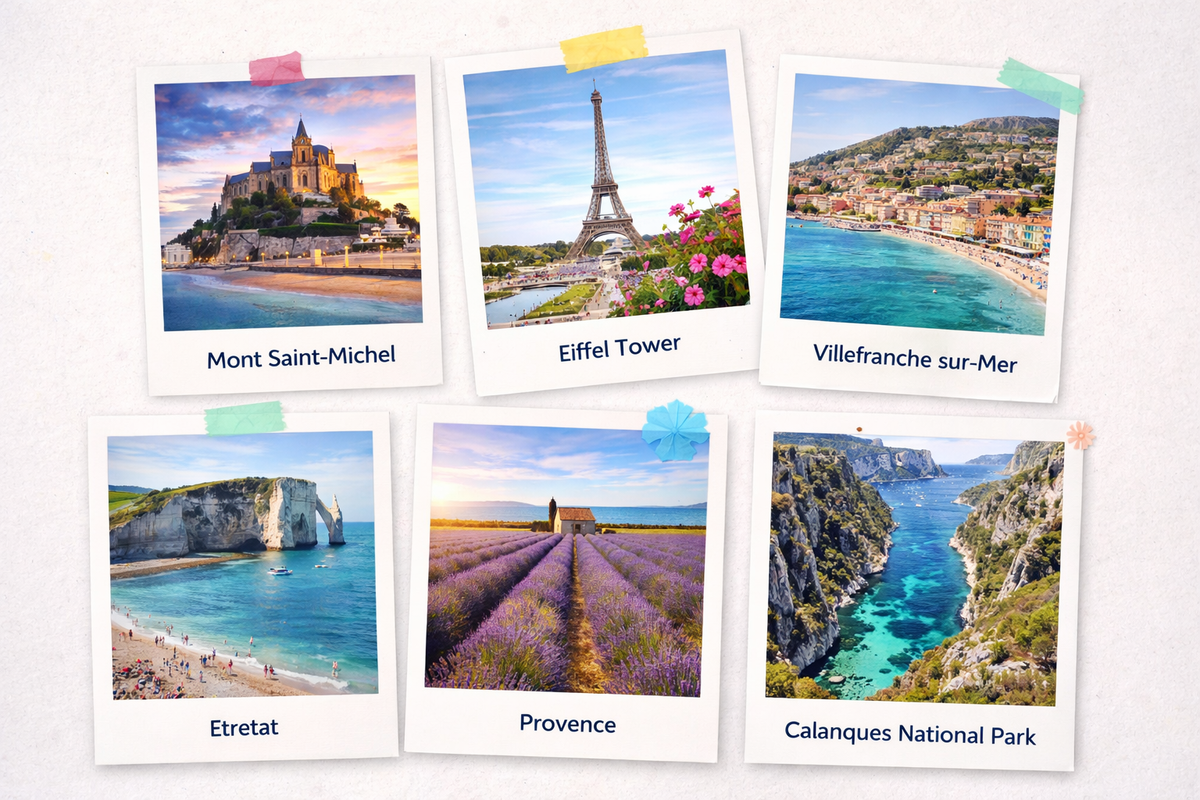
France is the world's most visited country, and summer is its most vivid season. Long golden days, lavender fields in full bloom, Mediterranean beaches, and a pace of life that genuinely slows down in the best possible way. A summer vacation in France in 2026 can be as iconic as the Eiffel Tower at sunset or as quietly perfect as a glass of wine in a Provençal vineyard at dusk.
This blog covers 10 dream spots across the country, with practical itinerary details, real costs pulled from a confirmed 3-day Paris to Nice route, and everything US travelers need to know before landing at Charles de Gaulle.
France in the Summer: What to Expect
July and August bring warm temperatures, long days (sunrise around 6 am, sunset as late as 9 pm), and an energy that makes France feel like the entire world has shown up at once. South France hits 26 to 32°C. Paris sits at a comfortable 22 to 28°C. The French Riviera is at its electric best.
Summer is peak season. Book flights 6 to 9 months in advance. Reserve restaurants 1 to 3 months ahead for the good ones. Buy attraction tickets online before you travel. Hotels in Paris, Nice, and Cannes are at premium rates from late June through August. The earlier you plan, the more you save.
What is the Weather of France by Region?
France can feel very different depending on where you are. Use this quick regional guide to plan outfits, hydration, and day timing more realistically.
Paris
Warm overall, with the occasional afternoon storm. Light layers work well, but it is smart to keep a compact umbrella nearby.
French Riviera
Dry, sunny, and generally easier to handle because humidity stays low. This is classic beach-and-terrace weather.
Lyon and Avignon
Hot and often intense in the afternoon. Shade and hydration are not optional here, especially if you are sightseeing on foot.
French Alps / Annecy
Cooler and clearer than much of the country, which makes it ideal for hiking, lakeside walks, and active days outdoors.
Bordeaux
Warm, but usually softened by the Atlantic sea breeze. It often feels more comfortable than inland cities at the same temperature.
1. Paris: The City That Never Gets Old
Paris is one of the best holiday destinations in France, regardless of season, but summer brings something special. Parisians leave for the coast in July and August, which means quieter cafés, shorter queues at the Louvre, and a city that feels yours genuinely. Paris Plages turns the Seine riverbanks into pop-up beaches. Open-air cinema runs through July. The Luxembourg Gardens are at their greenest.
🗼 Paris 2-Day Itinerary
Accommodation: Hôtel Eiffel Turenne near Trocadéro - USD 207 (€180) per night average.
Paris summer vacation tip: Buy a Paris Visite transport pass covering all zones. Saves money and removes the friction of buying individual Metro tickets.
2. Nice: The French Riviera's Most Accessible City
Nice is the gateway to the French Riviera and one of the most rewarding places to vacation in France in summer. The Promenade des Anglais stretches 7 km along the seafront. Vieux Nice (Old Town) is a labyrinth of Baroque buildings, Cours Saleya flower market, and colourful shuttered facades. Baie des Anges offers a pebble beach, swimming in turquoise Mediterranean water.
Day trip options from Nice:
- Monaco: 30 min by train, USD 5 (€4)
- Cannes: 40 min by train, USD 8 (€7)
- Èze village: 20 min by bus, free entry
- Antibes: 30 min by train, USD 7 (€6)
3. Cannes: Glamour, Old Town, and the Film Festival Afterglow
Cannes is one of the most famous places to vacation in France, and summer is when it hits its stride. The Cannes Film Festival ends in May, which means July brings the glamour without the festival crowds or press frenzy. The Croisette boulevard is lined with luxury hotels, designer boutiques, and private beach clubs. But the real Cannes is Le Suquet, the old quarter, where narrow streets wind up to a castle with views over the bay.
What to do:
- Walk the Boulevard de la Croisette (free, best in early morning or after 6 pm)
- Climb Le Suquet to the castle viewpoint (free, 20-minute walk)
- Ferry to Îles de Lérins - USD 21 (€18) return, 15 minutes. Swim in clear water away from the main beach crowds
- Beach clubs on Plage de la Croisette: public sections are free, private clubs from USD 29-58 (€25-50) per sun lounger
Travel note: Cannes is 40 minutes from Nice by train - USD 8-12 (€7-10). Easy day trip or overnight stop.
4. Avignon and Provence: Lavender, History, and the South of France at Its Purest
Avignon is one of the best holiday destinations in France for travelers who want culture without the coastal price tag. The medieval Palais des Papes is one of the largest Gothic palaces in the world, and the city's walled historic centre is a UNESCO World Heritage Site. The famous Pont d'Avignon sits half-broken across the Rhône. In July, the Festival d'Avignon brings world-class theatre and performance to every corner of the old city.
Beyond Avignon, the Provence lavender fields peak in late June and early July. The Valensole Plateau is the most photographed. The Senanque Abbey near Gordes, with lavender growing right up to the 12th-century stone walls, is the most spectacular.
Day trips from Avignon: Les Baux-de-Provence (25 min drive), Gordes (45 min drive), Aix-en-Provence (1hr by train).
Getting there from Nice: TGV, approximately 2hr 30min, from USD 29 (€25).
5. Lyon: France's Gastronomic Capital
Lyon is consistently ranked among the best holiday destinations in France by travelers returning after Paris. UNESCO designated Lyon's historic Vieux-Lyon quarter as a World Heritage Site. Its Renaissance buildings, traboules (hidden passageways through buildings), and riverside promenades along the Saône and Rhône are exceptional. Lyon is the self-declared gastronomic capital of France. The bouchons (traditional Lyon bistros) serve quenelles, andouillette, and tarte praline in a way that feels completely authentic.
What to do:
- Vieux-Lyon: walk the traboules and Renaissance courtyards (free)
- Basilique Notre-Dame de Fourvière: tram up the hill, panoramic view over the city (free)
- Les Halles de Lyon Paul Bocuse: covered market with 50+ vendors (free entry, budget USD 23-46 / €20-40 for tastings)
- Confluence district: modern architecture and contemporary art museum
Getting there from Paris: TGV from Paris Gare de Lyon, 2 hours, from USD 40 (€35) on sncfconnect.com.
6. Annecy: The Venice of the Alps
Annecy earns its nickname immediately. Canals lined with geranium-covered balconies run through the old town. Lake Annecy is one of the clearest lakes in Europe, and the turquoise water is genuinely swimmable throughout July and August. The Château d'Annecy overlooks everything from a hill, and the surrounding Alps create a backdrop that makes you understand why people come here and stay.
France in the summer does not get more beautiful than Annecy on a clear July morning.
What to do:
- Cycle the 40km loop around Lake Annecy (bike hire from USD 17 / €15 per day)
- Swim at the Plage d'Albigny (free, pebble beach, clear water)
- Paragliding from Planfait (from USD 115 / €100 for a tandem flight with an instructor)
- Walk the old town: Palais de l'Isle, Rue Sainte-Claire, and the canal district
Getting there: From Lyon by train, 1hr 50min. From Paris: TGV to Lyon, then connection, approximately 3.5 hours total.
7. Bordeaux: World-Class Wine and a Walkable City
Bordeaux is one of the great places to vacation in France that many US travelers underestimate until they arrive. The city was comprehensively renovated in the 2000s and is now a UNESCO World Heritage city with a riverfront promenade along the Garonne, elegant 18th-century neoclassical streets, and the Place de la Bourse reflected in the Miroir d'Eau (Water Mirror), the world's largest reflecting pool.
Bordeaux sits at the centre of the world's most important wine region. Within 30 minutes by car, you are in Médoc, Saint-Émilion, or Sauternes. The Cité du Vin wine museum is one of the best-designed cultural experiences in France.
What to do:
- Place de la Bourse and Miroir d'Eau (free, best at dusk)
- Cité du Vin museum - USD 25 (€22), allow 3 hours
- Day trip to Saint-Émilion (45 min by train from USD 12 / €10, wine tasting from USD 17 / €15)
- Marché des Capucins covered market on Sunday morning (free entry)
Getting there from Paris: TGV direct, 2hrs 4mins, from USD 40 (€35).
8. Mont Saint-Michel: France's Most Dramatic Landmark
Mont Saint-Michel is one of the most iconic images in Europe. A medieval abbey and village perched on a granite rock in a tidal bay, accessible by causeway when tides allow. The tidal range here is among the highest in Europe. During high tide, the island is completely surrounded by water. During low tide, the bay reveals vast sand flats stretching to the horizon.
What to do:
- Abbey of Mont Saint-Michel - USD 15 (€13) entry, opens 9 am
- Walk the ramparts surrounding the village (free once inside the gates)
- Guided walks across the sand flats at low tide - from USD 12 (€10) with certified guides
- Omelette at La Mère Poulard, the legendary restaurant on the main street - USD 29-46 (€25-40), a tourist institution since 1888
Getting there from Paris: TGV from Paris Montparnasse to Rennes (1hr 30min, from USD 35 / €30), then regional train plus shuttle bus (1hr 15min).
9. Alsace and Colmar: Fairytale France
Alsace sits on the German border in northeast France and looks like nothing else in the country. Half-timbered houses painted in pastel shades, flower-lined canals, medieval watchtowers, and a wine trail that winds through some of the most scenic countryside in Europe. Colmar is the capital of the Alsatian postcard. Its Little Venice district can genuinely make you stop and reconsider your entire travel plan.
What to do in Colmar:
- Little Venice district by boat - USD 8 (€7), 30-minute canal tour
- Maison Pfister: the most photographed building in Colmar (free exterior)
- Unterlinden Museum: home to the Isenheim Altarpiece - USD 17 (€15) entry
- Alsace Wine Route: cycle from Colmar through Riquewihr, Ribeauvillé, and Kaysersberg (bike hire from USD 17 / €15 per day)
Getting there from Paris: TGV to Colmar via Strasbourg, approximately 2hrs 20min, from USD 52 (€45).
10. The French Alps and Chamonix: Adventure at Altitude
The French Alps in summer are a completely different proposition from winter. Ski slopes become hiking and mountain biking trails. Cable cars run to altitudes above 3,000 metres. The views of Mont Blanc (4,808m, the highest peak in Western Europe) from Chamonix are among the most dramatic landscapes in the world. This is one of the best places to vacation in France for travelers who want to step completely outside city life.
What to do:
- Aiguille du Midi cable car from Chamonix - USD 77 (€67) return, summit at 3,842m, views of Mont Blanc and three countries
- Mer de Glace glacier: mountain railway from Chamonix - USD 40 (€35) return
- Hiking the Lac Blanc trail: 4-5 hour round trip, moderate difficulty, spectacular Alpine lake views
- Annecy day trip: 1hr 15min by bus from Chamonix
Getting there from Paris: TGV to Geneva (3hr, from USD 52 / €45), then bus to Chamonix (1hr 30min, USD 29 / €25).
France Summer Vacation: Practical Budget Guide
Based on a 3-day Paris to Nice itinerary
International flights from the USA: Add USD 800-1,400 for round-trip transatlantic airfare, depending on departure city. New York, Boston, and Miami offer the most direct options.
Is USD 1,000 enough for a week in Paris?
For US travelers, USD 1,000 covers approximately 4 to 5 days of land costs in Paris at a mid-range budget, excluding international flights. A realistic daily Paris budget is USD 150-200 per person for mid-range accommodation, one sit-down meal, and 1 to 2 paid attractions. Budget travelers keeping to cafés, street food, and free attractions can manage USD 80-100 per day.
Pre-Trip Checklist for Americans Traveling to France
Everything you need to book, pack, and know before you go, from entry requirements to tipping etiquette.
🗓️ Booking Timeline
🛂 Entry Requirements from the USA
US passport valid for the duration of your stay.
No visa required for stays under 90 days.
The EU travel authorisation launches Q4 2026, after the summer travel period. US travelers visiting France in July or August 2026 do not need an ETIAS for this trip.
Once launched, ETIAS will cost USD 23 (€20) and is valid for 3 years. Check before any future European trip.
Official EU ETIAS Portal ↗🎒 What to Pack
💡 Important Notes for US Travelers
Tipping is not required. Service is included in all restaurant bills. Leave small change if you are pleased - not a percentage.
English is spoken in all tourist areas. Basic French phrases are appreciated - even a simple bonjour and merci go a long way.
Beware of pickpockets in the Paris Metro, Montmartre, and the Eiffel Tower area. Keep valuables in a front pocket or money belt.
Staying Connected in France: eSIM for France
France spans 10 destinations in this guide alone, from Paris in the north to Chamonix in the Alps. Every time you step off a TGV in a new city you need maps, translation, restaurant bookings, and transport apps working immediately.
An eSIM for France installed before departure means working data before you clear immigration at Charles de Gaulle. No airport SIM kiosk, no roaming shock on your next bill, no dead phone in an unfamiliar city.
For Americans traveling to France across multiple regions, a single travel eSIM covers the entire country on one plan without interruption.
eSIM for France - One Plan, Every Region
Install via QR code before departure. Data working the moment wheels touch down at CDG or Nice.
Get Jetpac eSIM for France ↗QR code install before departure. Google Maps, Google Translate, and restaurant bookings are working the moment the wheels touch down at CDG or Nice Cote d'Azur.
Paris, Nice, Lyon, Bordeaux, Avignon, Annecy, Alsace, Mont Saint-Michel, Chamonix. One eSIM for France, one plan, no switching between regions.
WhatsApp, Google Maps, and Uber keep working even after you hit your data limit. Critical when navigating the Paris Metro at midnight or finding your hotel in a medieval Alsatian village.
When a quick call to a restaurant or hotel solves what ten messages cannot, especially useful across French-language interactions.
Share your connection with a travel partner or laptop without extra steps. Useful for booking last-minute TGV tickets or checking into accommodation on the go.
Automatically connects to the strongest available network across France, whether you are in central Paris or hiking above the treeline in Chamonix.
Fast enough for maps, translation, QR code menus, and real-time navigation without lag.
Significantly less than activating your US carrier's international plan for a France trip. More budget for the food.
If your plans change before travel, you are covered.
Available around the clock from any city in France, in any time zone.
FAQs
When does summer vacation start in France?
Summer in France effectively begins in late June when French schools break for the grandes vacances. The official school summer holiday typically runs from late June to the first week of September. For tourists, peak summer runs from July 1 to August 31, with July being the most vibrant month for events and festivals.
How long is summer vacation in France?
The French school summer holiday (grandes vacances) lasts approximately 8 weeks, running from late June or early July to early September. France divides school holidays across three zones (A, B, C) to stagger travel pressure on transport and tourist destinations. For US travelers, this means peak crowds in most destinations run from July through mid-August.
What is the 5 to 7 rule in France?
The 5 to 7 rule (cinq à sept) refers to the French social custom of socialising between 5 pm and 7 pm, typically involving drinks at a café or bar after work. It reflects France's tradition of a later dinner hour (most restaurants do not fill for dinner until 8 to 8:30 pm) and the importance of social time that is neither work nor a formal dinner. For US travelers, arriving at restaurants before 7 pm will often get you seated quickly ahead of the main French dining wave.
Is USD 1,000 enough for a week in Paris?
For US travelers, USD 1,000 covers approximately 4 to 5 days of land expenses in Paris at a mid-range budget, excluding international flights. A realistic daily Paris budget is USD 150-200 per person for mid-range accommodation, one sit-down meal, and 1 to 2 paid attractions. Budget travelers keeping to cafés, street food, and free attractions can manage USD 80-100 per day.
Where is the best place to visit in France in the summer?
For first-time visitors from the US, Paris remains the essential starting point and one of the best holiday destinations in France year-round. For the best overall summer experience, the combination of Paris (2 days) and Nice/French Riviera (3 days) accessed by TGV is the most rewarding itinerary. For those returning to France, Provence during lavender season (late June to mid-July), Annecy, and Lyon represent the best holiday destinations in France that most US travelers have not yet experienced.
Disclaimer
This blog is based on the confirmed 10 Dream Spots for Summer Vacation in France 2026 reference itinerary, verified travel sources, and publicly available information as of March 2026. Attraction prices, train fares, and restaurant details are subject to change. Always verify the latest pricing at official venue websites before booking. International flight estimates are indicative and based on historical fare ranges. All Euro amounts in this guide have been converted to US Dollars at an approximate rate of 1 EUR = USD 1.15, based on the EUR/USD exchange rate as of March 2026. Currency conversion amounts are indicative only and will vary based on the rate at the time of travel and the payment method used. Always check the latest exchange rate before travel at xe.com or your bank. ETIAS (EU travel authorisation) is expected to launch in Q4 2026 after the summer travel season. US travelers visiting France in summer 2026 are not affected. Always verify entry requirements at travel-europe.europa.eu before travel. Jetpac is not responsible for network variations or outcomes related to travel decisions made based on this content.