
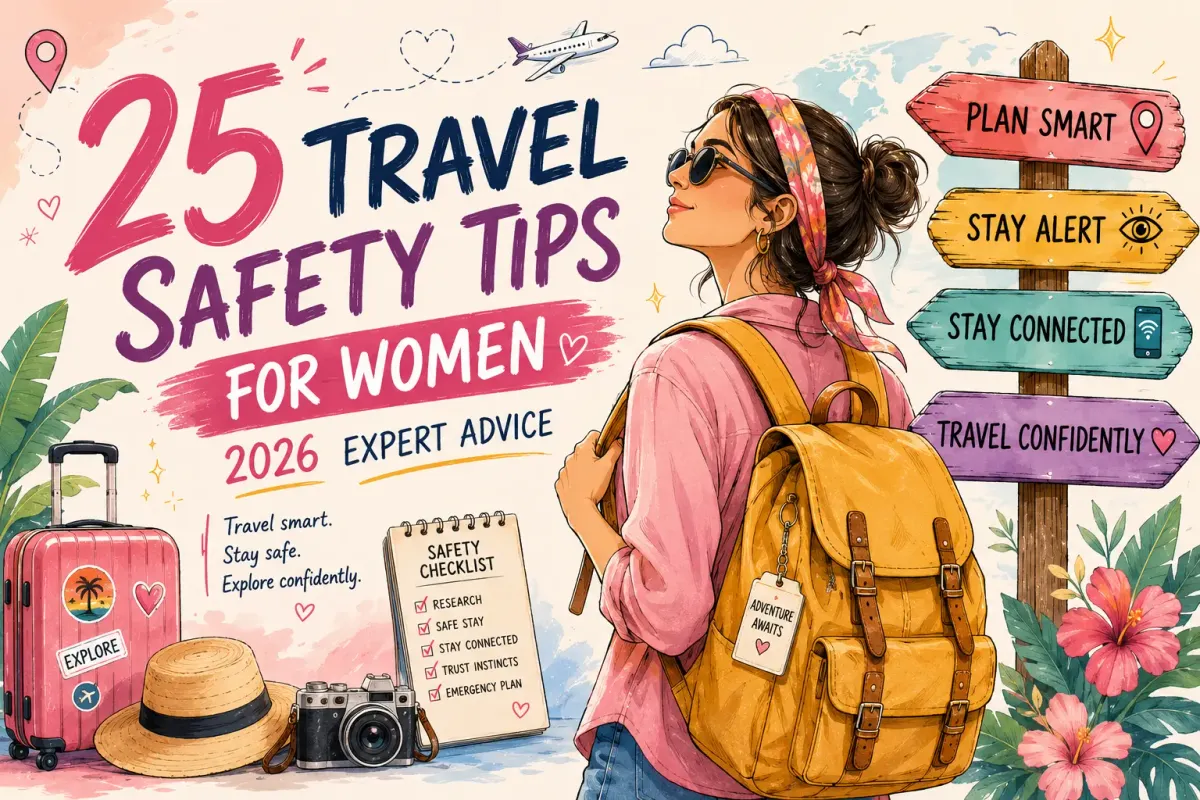
25 Travel Safety Tips for Women: 2026 Expert Advice
Solo female travel can be safer with the right preparation. Research your destination, choose secure accommodation and transport, protect money and documents, stay connected, share your location privately, trust your instincts, and know what to do during emergencies or unsafe encounters.
Women travel independently every day, all over the world, and the vast majority of those trips pass without incident. Preparation is not about fear. It is about making an unfamiliar destination easier to move through, so your attention stays on the trip rather than on second-guessing every decision.
And wherever you go, the single thread running through almost every safety decision is staying connected: a phone that works the moment you land lets you map a route, book a licensed ride, share your location, or call for help without hunting for public Wi-Fi first.
These travel safety tips for women cover the practical ground: destination research, accommodation, transport, money and documents, night-time travel, harassment, digital privacy, and staying reachable through a reliable international eSIM or travel eSIM.
The advice draws on official guidance from the UK Foreign, Commonwealth and Development Office (FCDO) and the US State Department, alongside established solo female travel expertise.
One thing to hold onto before you read on. No safety measure removes every risk, and where harm does occur, responsibility lies with the person causing it, never with the traveller. The aim of this solo female travel advice is informed, confident travel in 2026, not anxiety.
Quick Safety Checklist for Women Travellers
25 Travel Safety Tips for Women
These travel safety tips for women are grouped into seven areas, from pre-trip planning to what to do if something goes wrong. Whether it is your first trip or your tenth, these solo travel tips for women work the same way: read straight through, or jump to the section you need. If you are still deciding where to go, it is worth pairing this with a guide to the best places to travel solo before you book.
Planning and Research
Good preparation is where most solo female travel safety tips begin, because the decisions you make before you leave shape how easy everything else is. These solo travel tips for women start well before the airport.
#1. Research More Than the Country's Overall Safety Rating
A national safety label tells you very little about the street you will actually be standing on. Safety varies enormously by region within a single country, so research the specific city, neighbourhood and transport routes you will use, not just the headline ranking or lists of the safest countries in the world.
Before you go, check government travel advice, local laws, areas to avoid, common scams, transport after dark, and cultural expectations around dress and behaviour. The FCDO provides current destination information on security, health, entry requirements and local laws for destinations worldwide, and it is the most authoritative starting point for UK travellers.
Guidebooks, recent forum posts and other women's trip reports fill in the practical detail official advice cannot. This kind of groundwork is the foundation every other one of these solo travel safety tips builds on.
#2. Buy Suitable Travel Insurance
Check the policy covers medical treatment, cancellation, lost documents, theft, emergency transport and any activities you have planned. Read the small print, because cover can be invalidated by travelling against official advice or by alcohol use, so know what would void your policy before you rely on it.
Keep the policy number and 24-hour assistance line saved offline.
#3. Prepare for Your Health and Medication Needs
Check whether any medication you carry is legal at your destination, since some common prescriptions are restricted or banned in certain countries. Carry medicines in their original packaging with a copy of the prescription, pack enough for the whole trip plus a few spare days, and split it across two bags so losing one does not leave you without.
Note any allergies or conditions somewhere accessible in case you cannot speak for yourself.
#4. Share a Simple Itinerary With Someone You Trust
Leave a trusted person your flight details, accommodation, transport plans, excursions, and emergency contacts, and agree how often you will check in. Keep the check-in rhythm realistic.
A schedule you cannot maintain causes needless alarm when you miss it, so "a message each evening" works better than rigid hourly updates.
#5. Save Essential Information Offline
Store offline copies or screenshots of your passport, visa, insurance, hotel details, tickets, emergency contacts and local maps. Working through a full international travel checklist before you leave is the simplest way to make sure nothing essential is missing.
The FCDO specifically recommends a backup plan for accessing key information in case you lose your phone, including whether you could still reach your money if you could not complete two-factor authentication. Keep sensitive copies behind a device password or in encrypted storage.
Read more: Make every trip smoother with 18 best travel hacks that will save you money and time, covering smarter bookings, airport shortcuts and practical travel planning.
Arrival and Getting Around
Arrival and transport are where many female safety tips matter most, since a new city is hardest to read when you have just landed. These tips for travelling alone as a woman focus on the moments between the airport and your door.
#6. Plan Your First Arrival Before Departure
You are at your most vulnerable when you first arrive somewhere new: tired, unsure of your surroundings, and easy to spot as a newcomer. Knowing exactly how you will get from the airport or station to your accommodation removes the moment of hesitation that opportunists look for.
This is among the most useful airport travelling tips for solo women: have the arrival sorted before you land.
Save the accommodation address, transfer details, offline directions, estimated journey cost, and a backup transport option before you fly. Where you can, arrange a daytime arrival, and pre-book a licensed transfer for the first night.
#7. Use Licensed Taxis or Verified Rideshare Services
Confirm the number plate, driver name, vehicle model, and app route before you get in. App-based transport is safer precisely because it creates a record of your ride, can require the driver to verify a personal identification number (PIN) at pickup, and lets you share the trip in real time. Never get into a vehicle just because the driver knows your name or destination, a common trick at airports and stations.
#8. Sit Where You Feel Most Comfortable
In a taxi or rideshare, choose a seat with easy access to a door. Keep your phone and belongings with you rather than in the boot unless there is no alternative, so you are never separated from your means of calling for help.
#9. Avoid Isolated Transport Stops at Night
Wait in a staffed, well-lit or busy area wherever possible. When public transport becomes infrequent, or the platform empties, paying more for a licensed taxi or rideshare is usually worth it. The cost of a safer journey is almost always smaller than it feels in the moment.
Read more: Flying alone for the first time? Follow Travel tips for first-time flyers: Guide from booking to landing for airport navigation, baggage, security and arrival guidance.
Accommodation
Where you stay shapes how safe a trip feels day to day, so these solo female travel tips cover choosing, checking and settling into a room.
#10. Choose Accommodation in a Well-Connected Area
Prioritise a location near reliable transport, restaurants and active streets over a cheaper option somewhere isolated. Being able to walk back to a lit, busy street matters more than a slightly lower nightly rate.
Read recent reviews specifically for comments on walking alone in the area, street lighting, reception access, door security, and what the surrounding streets are like after dark. Reviews from other solo women travellers are especially useful here.
#11. Check Your Room as Soon as You Arrive
Before you settle in, confirm the locks work, the windows close securely, the phone reaches reception, you know the nearest exit, any connecting doors are locked, and no maintenance issue affects security.
Experienced travellers, including the team at JourneyWoman, recommend running your own quick accommodation-safety check rather than assuming the hotel has covered everything. Some women also carry a portable door lock or door-stop alarm, though it is worth knowing a device that fully blocks a door can also delay staff or emergency access, so decide what suits you.
#12. Check for Hidden Cameras
Hidden cameras in rentals and hotel rooms are rare but worth a two-minute check, especially in private rentals. Scan for objects with an unobstructed view of the bed or bathroom, such as smoke detectors, alarm clocks, sockets, air purifiers and decorative items, and look for anything out of place or oddly positioned.
Turn off the lights and slowly sweep the room with your phone camera or torch, watching for small reflective glints that can reveal a lens. Check mirrors and any device with a small hole in it. If something feels wrong, cover it, and report it to the platform or hotel.
#13. Do Not Open the Door Without Verifying the Visitor
If someone claims to be hotel staff, call reception to confirm before opening. Use the peephole or door camera, and keep the security latch engaged while you speak. Genuine staff will not mind waiting while you check.
#14. Keep Your Accommodation Details Private
Avoid sharing your room number, exact apartment address, door codes, real-time check-in posts, or photos showing identifying details. When checking in, the State Department suggests registering with your first initial and no title, so a booking or key sleeve does not immediately signal that a woman is staying alone.
Post location-specific content after you have left, rather than while you are there, to keep your current whereabouts private without spoiling the trip diary.
Money, Documents and Belongings
#15. Separate Your Money and Payment Cards
Do not keep every payment method in one purse. Carry one daily-use card, limited cash, a separately stored backup card on a different network (one Visa, one Mastercard), and a small amount of emergency money kept apart from the rest. Avoid opening your main wallet in crowded places, since that is exactly where a watcher decides you are worth following.
#16. Carry Valuables in a Secure, Closed Bag
Use a bag that closes fully and sits close to the body, ideally a cross-body anti-theft design. Keep your passport, phone and wallet out of easy-to-reach outer pockets. Carrying less in the first place is the simplest protection: only what you need for the day leaves the accommodation.
#17. Avoid Displaying Your Room Number Publicly
Do not say your room number aloud in busy hotel areas, and ask reception to write it down rather than announce it. Do not leave a labelled key where strangers can read it. It is a small habit that quietly removes a piece of information a stranger could use.
Read more: Want to reduce costs without compromising safety? Explore How to travel on a budget: 20 smart money-saving travel tips for flights, accommodation, transport and daily expenses.
Awareness and Personal Safety
Awareness is the thread running through most solo female travel tips, and these tips for travelling solo safely are about trusting your judgement and acting on it early.
#18. Stay Aware Without Looking Anxious
Walk with purpose and avoid disappearing into your phone on the street. When you need to check directions, step inside a shop, café or hotel lobby to do it. Looking like you know where you are going is a quiet deterrent in itself.
#19. Trust Discomfort and Leave Early
You do not need proof that a situation is dangerous before you remove yourself from it. If something feels off, that is enough. Move towards staff, families, a busy business, security personnel, or a well-lit public area.
Leaving early and being wrong costs you nothing, and stepping away from a situation that feels wrong is always a reasonable choice.
#20. Set Boundaries Without Worrying About Politeness
When you need to, use clear, short language: "No." "Please step back." "I am not interested." "Do not follow me." As the State Department puts it, being safe is more important than being polite.
Do not debate or overexplain. A firm voice and unambiguous words end far more unwanted encounters than a reasoned argument does.
#21. Take Extra Care With Alcohol and New Acquaintances
Keep control of your drink and arrange your return transport before you go out. Do not leave a drink unattended or accept one from a stranger. This is not about limiting your enjoyment or shifting blame; it is about keeping control of your own plans and transport.
Be aware of spiking. Drugs used to spike drinks are usually colourless and tasteless, work in non-alcoholic drinks such as coffee or tea as well as alcohol, and take effect quickly.
If you feel strange, sick or drunk after only a small amount, tell someone you trust or venue staff straight away and seek help. If you are assaulted, get medical care as soon as possible, ideally within 72 hours, as some treatments are time-sensitive.
#22. Build a Trusted Local Anchor
Having one reliable local point of contact makes a place feel navigable and gives you somewhere to turn. Your accommodation reception is the obvious anchor: introduce yourself, ask their advice on areas and transport, and save their number.
A reputable nearby café, shop or a verified tour operator can serve the same purpose. Locals who work in hospitality usually know exactly which streets and situations to avoid, and most are glad to help.
Technology and Connectivity
Staying connected underpins many of the practical solo travel safety tips above, from sharing your location to booking a safe ride.
#23. Keep Reliable Mobile Data Available
A charged, connected phone is one of the most useful safety tools you carry. It handles maps, transport booking, translation, hotel communication, location sharing, emergency information and travel alerts, all of which matter most in exactly the moments you cannot rely on finding public Wi-Fi.
An international eSIM or travel eSIM lets you land already connected, so you can order a licensed rideshare, check a route or share your location the moment you arrive rather than hunting for a signal. Keeping your home embedded SIM (eSIM) or physical SIM active alongside a travel eSIM is worth doing too, so home contacts can still reach you, and bank verification codes still arrive.
When comparing options, Jetpac is one international eSIM worth looking at, covering over 200 destinations with hotspot sharing and apps like WhatsApp and Google Maps that keep working even after your data allowance runs out, useful if you are finding your way somewhere on the last of your data. Whichever provider you choose as the best eSIM for international travel, install and test it before you leave, and carry a power bank so the phone never dies when you need it.
#24. Share Your Live Location and Drop Pins
Share your live location privately with one trusted contact using Google Maps or Find My, with an agreed "until I turn this off" arrangement. Drop a pin on your accommodation and any planned stops so someone knows your intended route. The distinction that matters is private versus public: share real-time location with a trusted person, never broadcast it on social media while you are still there.
#25. Carry Emergency Information You Can Reach Without Your Phone
Your phone can be lost, stolen, or dead in exactly the moment you need it, so keep a written backup. Carry a small card with your emergency contacts, blood type, or key medical information, insurer's assistance line, and accommodation address, kept separately from your phone.
Set up your phone's built-in emergency features too: the Medical ID and Emergency SOS on most smartphones can share your location and alert your contacts with a few button presses, and work from the lock screen.
Read more: Keep important tools within reach with 26 best travel apps for planning trips like a pro, including apps for navigation, bookings, transport and trip organisation.
Emergency numbers to save before travelling
Know the local emergency number before you need it. Tap a number to dial.
European Union and neighbouring countries
Reaches police, fire and ambulance. It works free on any mobile, even with no SIM, no credit, or a locked keypad.
Check the destination’s official travel-advice page for the right number before departure, and save the nearest embassy or consulate contact offline. US citizens can enrol free in the Smart Traveler Enrollment Program (STEP) for embassy alerts. UK travellers can find consular contacts on the relevant FCDO country page.
What to Do if You Feel You Are Being Followed
Stay calm and give yourself options rather than heading straight home.
Do not return directly to your accommodation, as this reveals where you are staying. Instead, step into a busy business or hotel, approach staff or security, and call a trusted contact so someone knows where you are. Contact local emergency services if you need to.
Note identifying details, such as clothing or direction of travel, only if it is safe to do so, and change your route or transport to break the pattern. A hotel lobby, a pharmacy, a supermarket, anywhere staffed and busy, buys you time and witnesses.
What to Do During Harassment or an Unsafe Encounter
The right response depends entirely on the situation, and your judgement in the moment matters more than any script.
Options include moving closer to other people, using a clear verbal boundary, alerting staff, leaving immediately, calling emergency services, contacting your accommodation or transport support, documenting the incident once you are safe, and seeking medical or consular help where relevant.
Speaking loudly can help, since drawing attention often stops unwanted behaviour. Whatever happens, the responsibility lies entirely with the person causing the harm. Nothing you wore, said, or did shifts that.
Read more: Travelling later in life requires a few extra precautions. Read 18 travel tips for senior citizens: Health, safety and savings for practical planning and comfort advice.
How to Handle a Lost Phone, Wallet or Passport
Deal with the immediate priorities in order.
Move to a safe location first. Lock or track the phone remotely, and freeze any affected payment cards. Contact the police if the situation requires it, and get a report reference, since your insurer will need it. Notify your insurer, and contact the relevant embassy or consulate for help replacing a lost or stolen passport.
This is where the offline document copies and separately stored emergency funds from earlier earn their place. Embassies and consulates can assist their citizens during emergencies abroad, including lost-passport and crime-related situations.
Common Solo Female Travel Mistakes to Avoid
Even the best tips for solo female travellers only help if the common traps are avoided. These are the female safety tips people most often overlook, in brief:
- Arriving without a transfer plan.
- Booking solely on price.
- Sharing live locations publicly.
- Carrying every card in one place.
- Ignoring local laws.
- Using unverified transport.
- Giving strangers too much personal information.
- Depending entirely on public Wi-Fi.
- Drinking beyond your own limits.
- Staying in an uncomfortable situation to appear polite.
None of these makes anyone responsible for harm done to them. They are simply the habits most worth breaking, because each one removes an option you might later want.
Final Thoughts on Travelling Safely as a Woman
Effective travel safety tips for women come down to a handful of habits: research, reliable transport, secure accommodation, awareness, communication, backup planning, and trusting your own judgement.
Taken together, these tips for travelling solo safely fade into the background, which is the point. If you want to go deeper on any one area, a dedicated solo travel tips guide is a useful companion to this piece.
Preparation should widen your freedom, not shrink it. The women who travel confidently are rarely the ones who worry most; they are the ones who have handled the practical groundwork and can then stop thinking about it. Do the preparation, then go and enjoy the trip you came for.
FAQs
Is it safe for a woman to travel alone internationally?
For the most part, yes, and millions of women do it every year. The most reliable solo female travel advice in 2026 is that safety depends far more on the specific destination and your preparation than on travelling alone as such. Research your exact destination, check official advice from sources like the FCDO or the State Department, choose accommodation and transport carefully, and stay reachable. Confidence tends to grow with experience, and many solo female travellers report feeling safer on later trips than on their first.
How should a woman choose a safe hotel when travelling alone?
Prioritise a well-connected location near transport and busy streets, read recent reviews for comments on the area after dark and on door and reception security, and favour places with 24-hour staff. On arrival, check that locks and windows work and that you know the nearest exit. Reviews written by other solo women travellers are particularly useful.
Is it safer to stay in a hotel or holiday rental as a solo woman?
Both can be safe, and each has trade-offs. Hotels usually offer 24-hour reception, staffed entry and someone to call at night, which many solo travellers value. Holiday rentals offer privacy and a residential setting but often no on-site staff. If you choose a rental, prioritise secure entry, a good safety track record in reviews, and a responsive host, and give the room a quick hidden-camera check on arrival.
How can female travellers stay safe when arriving after dark?
Where possible, plan a daytime arrival. Among the most useful tips for travelling alone as a woman: if you must arrive at night, pre-book a licensed transfer or verified rideshare rather than sorting transport on the spot, save offline directions, keep your phone charged and connected, and share your live location with a trusted contact until you are checked in.
What should a woman do if she thinks she is being followed?
Do not go straight to your accommodation. Step into a busy, staffed place such as a hotel, shop or pharmacy, alert staff or security, and call a trusted contact or emergency services if needed. Change your route or transport, and note identifying details only if it is safe.
Should solo female travellers share their live location?
Sharing your live location privately with one trusted contact is a useful safety measure, through Google Maps or Find My with an agreed "until I turn this off" arrangement. The distinction that matters is private versus public: share your real-time location with a trusted person, but avoid posting it publicly on social media.
How can women stay safe in taxis and rideshares abroad?
Use licensed taxis or verified rideshare apps, and confirm the plate, driver, and vehicle against the app before getting in. Sit where you can reach a door, keep your belongings with you, share your trip in real time, and never get in simply because a driver knows your name or destination.
What safety items should a solo female traveller carry?
A charged phone with mobile data, a power bank, offline copies of key documents, a backup payment card stored separately, a written emergency-information card, and a fully closing cross-body bag cover the essentials. One of the most practical tips for solo female travellers is to carry a door-stop alarm or personal alarm too. If you consider anything like pepper spray, check whether it is legal at your destination first, as many countries prohibit it and carrying it can be a criminal offence.
How should women respond to harassment while travelling?
Responses depend on the situation, and your judgement comes first. Options include a clear verbal boundary, moving towards other people, alerting staff, leaving immediately, and calling emergency services. Speaking loudly can draw helpful attention. Responsibility for harassment always lies with the person doing it, never with you.
What should a solo traveller do if her phone or passport is stolen?
Move somewhere safe, then lock or track the phone and freeze affected cards. Report the theft to the police and keep the reference for your insurer. For a passport, contact your embassy or consulate, which can help with an emergency replacement. Offline document copies and separately stored emergency cash make all of this far easier.
Disclaimer
This blog is for general informational and planning purposes only. Safety conditions, entry requirements, local laws and emergency contacts vary by destination and can change at any time. The guidance here draws on official sources including the UK Foreign, Commonwealth and Development Office and the US State Department, but no article can account for every situation, and no preparation guarantees safety. Where harm occurs, responsibility lies with the person causing it. Some safety items, including pepper spray, are illegal in certain countries; always check local laws before carrying them. Always check the current official travel advice for your destination, such as gov.uk/foreign-travel-advice or travel.state.gov, before you travel, and follow the guidance of local authorities and emergency services while abroad. Jetpac is not responsible for any inaccuracies, changes, or losses arising from reliance on this information.


